Call us at any time (904) 377-5084
Call us at any time (904) 377-5084

About Jax Pool Builders
Building a Pool at the Jacksonville Beaches: Local Guide
Building a pool at the Jacksonville Beaches — Atlantic Beach, Neptune Beach, and Jacksonville Beach — comes with two things that set the area apart.
First, each of these is a separately incorporated city with its own building department, so pool permits go through the city (Atlantic Beach, Neptune Beach, or Jax Beach), not the City of Jacksonville — even though they're all in Duval County.
Second, these are true coastal communities, so salt air, wind exposure, and flood-zone/elevation rules are major factors, and lots tend to be older and more compact. That combination makes fiberglass a popular choice for its efficient fit and fast install, and makes salt-resistant equipment and screen enclosures especially valuable.
Pools track the broader Jacksonville range of roughly $50,000–$120,000+, often trending higher given the premium coastal market.
Each beach city permits its own pools
This is the most important local difference at the Beaches:
Three separate city governments. Atlantic Beach, Neptune Beach, and Jacksonville Beach are each separately incorporated cities with their own municipal government and building department. Although they sit within Duval County, they do not permit through the City of Jacksonville.
Permit through your specific city. A pool in Atlantic Beach is permitted by Atlantic Beach; one in Jax Beach by Jacksonville Beach, and so on. Each city has its own process, and coastal cities often add resiliency and elevation requirements.
Use a builder who works your city. Because the permitting office and rules vary by beach city, a builder experienced at the Beaches — and in your specific city — makes the process far smoother.
For the general Florida pool rules — safety barriers, setbacks — see our permits & HOA guide; just note the permitting office is your beach city, not Jacksonville.
The three beach cities, briefly
Each has its own character that shapes pool projects:
Atlantic Beach — the northernmost, largely residential with a small seaside-town feel and an organized street grid. Homes range widely (from around $230,000 to multi-million-dollar), and the Atlantic Beach Country Club area has spurred higher-end construction. A mix of older cottages and newer high-end builds.
Neptune Beach — small, tucked-in, and laid-back, with roots going back to the 1890s. Quaint cottages and established homes on well-kept lots, some shaded by mature trees, close to the sand. A tight-knit, walkable community.
Jacksonville Beach — the commercial hub of the coast, with the highest concentration of condos, high-rises, and shopping. More multifamily housing alongside single-family neighborhoods.
Atlantic Beach and Neptune Beach share the walkable Beaches Town Center; Jax Beach is busier and more commercial.
Coastal factors to plan for (the heaviest of any Jax area)
The Beaches face the strongest coastal considerations in the Jacksonville market:
Salt air and corrosion. Ocean salt air is hard on pool equipment, fixtures, and finishes. Salt-resistant, coastal-rated equipment and materials are important here — regardless of whether you choose a saltwater system — simply because of the environment.
Flood zones and elevation. Flood zone, elevation, and insurance are front-and-center at the Beaches (Neptune Beach participates in the Community Rating System; Atlantic Beach emphasizes coastal resiliency in its planning). Many beach lots fall in flood zones, which can add elevation and drainage requirements to a pool project. Check your property's flood status early — it's not a last-minute detail in a beach market.
Wind exposure. Coastal wind loads matter for screen enclosures and any structures around the pool — enclosures should be wind-rated.
Tight, older lots. Many beach lots are smaller and closer together than inland areas, so pools are often designed efficiently to fit the space — the pool becomes the centerpiece of a compact backyard.
High water table near the coast. Dewatering during excavation is common and routine for coastal crews.
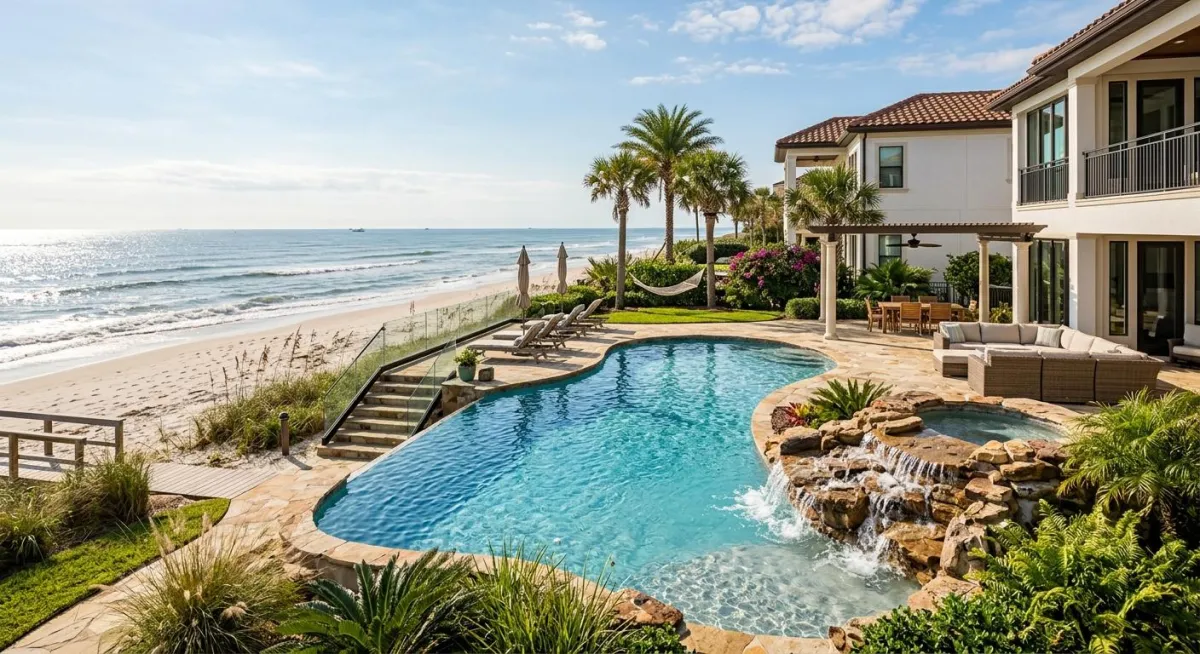
What kind of pool do people build at the Beaches?
Given the older homes and tighter, coastal lots, here's the guidance:
Fiberglass is often a great fit at the Beaches. With smaller lots where the pool takes up much of the yard, a pre-made fiberglass shell sized to the space installs fast and keeps maintenance low — a real plus in a salt environment. The wide range of shell shapes and sizes suits compact beach backyards well.
Existing pools may be gunite. If you're buying an older beach home with a pool, it may be gunite — be ready for older-gunite ownership costs (resurfacing, more upkeep), and check its condition given the harsh coastal exposure.
Gunite still makes sense if you want a fully custom shape to maximize an awkward or tight lot, or a higher-end design (common in Atlantic Beach's upper-end market). On a small lot, custom gunite can be shaped precisely to fit.
Whichever you choose, salt-rated equipment and a screen enclosure are smart calls in this environment. See our gunite vs. fiberglass guide.
What pools cost at the Beaches
Pool costs at the Beaches track the broader Jacksonville range — most inground pools run $50,000–$120,000+ — but often trend toward the higher end given the premium coastal market and added coastal requirements:
Coastal factors add cost. Salt-rated equipment, wind-rated enclosures, and any elevation/flood requirements can add to the total.
Screen enclosures are near-essential here — budget $12,000–$30,000 (and wind-rated for the coast).
Tighter lots often mean right-sized builds — efficient, well-designed pools rather than sprawling ones, though Atlantic Beach's higher-end market includes larger custom projects.
See full pricing in our Jacksonville pool cost guide and the budget tiers.
Get matched with Beaches pool builders
Tell us your budget and what you're planning, and we'll connect you — free — with pool builders who work at the Jacksonville Beaches and understand coastal construction, each city's permitting, and designing for tighter beach lots. No pressure, no obligation, and we're independent (we don't build pools ourselves).
Jacksonville Beaches Pool FAQ
How much does a pool cost at the Jacksonville Beaches?
Pool costs at the Beaches track the broader Jacksonville range — most inground pools run $50,000–$120,000+ — but often trend toward the higher end given the premium coastal market and added requirements like salt-rated equipment and wind-rated enclosures. Screen enclosures (near-essential here) add $12,000–$30,000.
Do I permit a beach pool through Jacksonville or the beach city?
Through your beach city. Atlantic Beach, Neptune Beach, and Jacksonville Beach are each separately incorporated cities with their own building departments, so pool permits go through the specific city — not the City of Jacksonville — even though they're in Duval County. Use a builder experienced with your city's process.
Do I need to worry about flood zones and salt air for a beach pool?
Yes to both. Many beach lots fall in flood zones, so elevation, drainage, and insurance are important to check early — flood status is not a last-minute detail in a beach market. And coastal salt air makes salt-resistant, corrosion-rated equipment and finishes a smart investment regardless of your sanitizing system.
Is fiberglass or gunite better for a beach pool?
Fiberglass is often a great fit for the Beaches' smaller, older lots — it installs fast, keeps maintenance low (a plus in a salt environment), and comes in sizes suited to compact backyards. Gunite still makes sense for a fully custom shape on a tight or awkward lot, or a higher-end Atlantic Beach build. Existing pools in older beach homes are often gunite.
Are the lots big enough for a pool at the Beaches?
Often yes, though many beach lots are compact. On smaller lots, the pool typically becomes the centerpiece of the backyard with efficient decking — which is why fiberglass shells sized to the space are popular. Some areas (parts of Atlantic and Neptune Beach) have larger, tree-shaded lots with more room.